
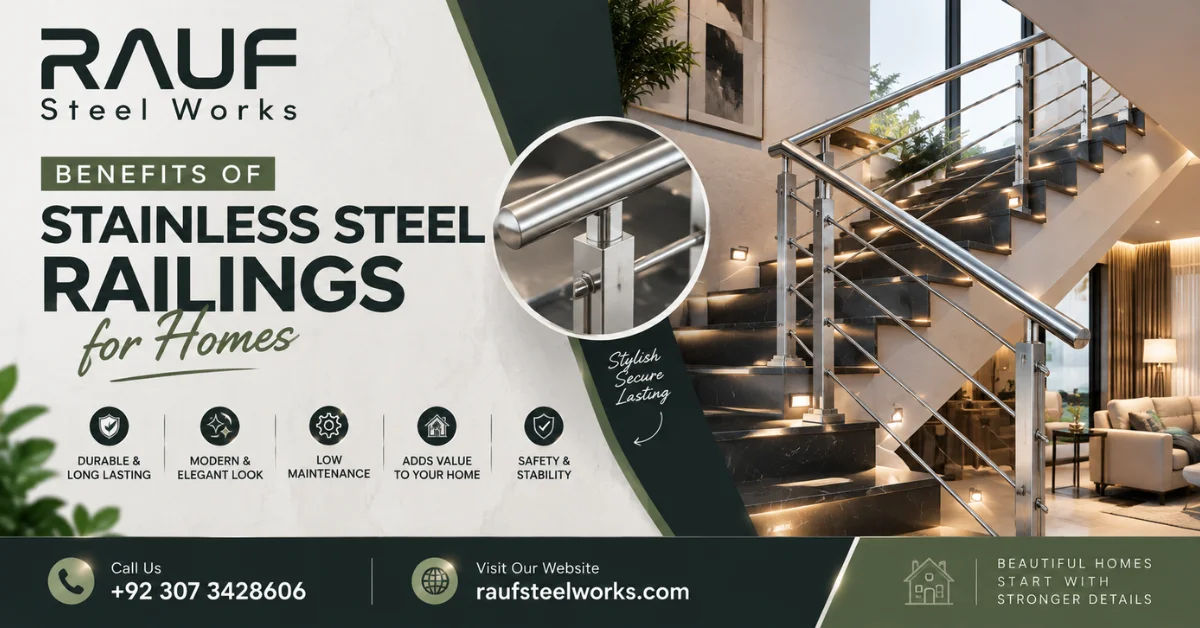
A railing isn’t a decorative afterthought — it’s one of the few home fixtures that gets touched, gripped, and leaned on every single day, and it takes the full brunt of sun, rain, and humidity while doing it. That combination of constant physical contact and constant weather exposure is exactly why material choice matters so much, and it’s why stainless steel railings have become the default upgrade homeowners across Lahore ask for once they’ve lived with an older iron or wood railing for a few years.
The construction industry’s own numbers back this shift up. According to a Grand View Research market report, increased focus on customized stainless steel railings in housing construction is specifically named as a driver of global stainless steel demand, alongside its corrosion resistance, formability, and weldability. That’s not a coincidence — it reflects a real, measurable shift in what homeowners are asking builders and fabricators for.
This guide walks through exactly why stainless steel railings deliver more value than the alternatives, backed by real engineering data rather than just marketing language — corrosion resistance, strength, safety compliance, maintenance cost, lifespan, and appearance — so you can decide whether it’s the right upgrade for your staircase, balcony, or terrace.
What Makes Stainless Steel “Stainless” in the First Place
To understand why stainless steel railings hold up the way they do, it helps to know what’s actually happening at a material level. Stainless steel is an iron alloy containing at least 10.5% chromium, and as ScienceABC’s materials explainer describes, that chromium reacts with oxygen faster than iron does, forming a nanometer-thin chromium oxide film that seals the surface and self-heals whenever it’s scratched. This is a fundamentally different mechanism from painted mild steel, where the protection is a surface coating that wears off — stainless steel’s protection regenerates itself for the life of the material.
The Real Benefits of Stainless Steel Railings
1. Corrosion Resistance That Doesn’t Wear Off
This is the single biggest reason stainless steel railings outperform every painted alternative. A mild steel railing relies entirely on its paint layer to keep moisture out — the moment that paint chips, scratches, or wears thin at a high-touch point (exactly where hands grip a railing), rust starts underneath it. Stainless steel’s chromium oxide layer, as industry research on passivation explains, reforms on its own when the surface is scratched, which means the protection doesn’t depend on maintenance the way paint does. In Lahore’s climate, with a genuinely humid monsoon season every year, this difference shows up fast on an unmaintained MS railing and essentially never shows up on a properly fabricated SS one.
2. A Genuinely Long Service Life
According to the World Stainless Association’s sustainability evaluation, stainless steel used in architecture and construction offers an operational life of at least 110 years with zero or minimal maintenance. Very few materials used in home construction can make that claim with this level of industry backing. For a railing — a structural, safety-critical fixture that’s expensive and disruptive to replace — that kind of lifespan is a genuinely different value proposition from a painted mild steel railing that needs repainting every two to three years just to stay presentable.
3. Structural Strength and Safety Compliance
Railings aren’t just decorative — they’re a safety barrier, and building codes treat them that way. This Old House’s staircase safety guide notes that stair railings are generally required to sit between 34 and 38 inches above the tread nosing, specifically because this range gives a secure, graspable grip that prevents falls. Stainless steel’s higher tensile strength compared to mild steel — commonly cited in the 500 to 1000 MPa range depending on grade — means a properly engineered SS railing resists bending and deformation under the lateral load a person applies when they lean on it or catch themselves during a fall, which is precisely the scenario a railing exists to handle.
4. Low Maintenance, Real Long-Term Savings
A mild steel railing needs a repaint cycle every two to three years to stay rust-free — that’s labor, material cost, and downtime every time it happens. A World Stainless Association industry overview notes that stainless steel needs no coatings at all, which effectively means zero recurring finishing cost across its service life. Over a 10 or 15-year ownership period, that difference adds up to real money saved on repainting alone, even before factoring in the cost of an early rust-driven railing replacement.
5. A Cleaner, More Modern Look — With No Repainting Needed
Stainless steel has a naturally bright, silvery finish that can be polished to a mirror shine or brushed for a softer matte look, and it holds that appearance without paint. This is part of why SS has become the default choice in the kind of modern steel gate and railing designs increasingly requested across newer Lahore housing societies — homeowners want a clean, minimal look that doesn’t fade or need repainting to stay sharp.
6. A Genuinely Sustainable Material Choice
For homeowners who care about the environmental footprint of their build, stainless steel has a strong case. The World Stainless Association reports that around 95% of end-of-life stainless steel is collected and recycled back into new stainless steel without any loss of quality — a recycling rate that outperforms most other common building materials. Combined with its multi-decade service life, a stainless steel railing represents a genuinely lower lifetime environmental footprint than a material that needs repeated painting, repair, or early replacement.
7. Higher Perceived Property Value
A polished stainless steel staircase or balcony railing reads as a premium finish the moment someone sees it, in a way a repainted mild steel railing generally doesn’t, regardless of how well it was maintained. For homeowners planning to sell or rent a property in the medium term, that first-impression value is a real, if harder-to-quantify, benefit worth factoring into the material decision.
Stainless Steel vs Other Railing Materials
| Property | Stainless Steel | Mild Steel (Painted) | Wood | Aluminum |
| Corrosion resistance | Excellent, self-healing | Poor without maintenance | Rots without sealing | Good, but softer |
| Structural strength | High tensile strength | Strong but softer than SS | Moderate, weakens over time | Lower than steel |
| Maintenance | Occasional cleaning | Repaint every 2–3 years | Regular staining/sealing | Occasional cleaning |
| Typical lifespan | 100+ years | 15–25 years with upkeep | 10–20 years | 30–40 years |
| Appearance | Bright, modern, polished | Needs paint for any finish | Warm, natural | Matte, lightweight look |
| Relative cost | Higher upfront | Lower upfront | Moderate | Moderate |
Where Stainless Steel Railings Work Best in a Home
- Staircases — the highest-touch railing in any home, where corrosion resistance and grip strength matter most.
- Balconies and terraces — full weather exposure makes SS’s corrosion resistance especially valuable here.
- Rooftop and boundary railings — constant sun and monsoon exposure with minimal shelter.
- Modern facade accents — slim SS railings paired with glass panels for a contemporary architectural look.
What Drives the Cost of Stainless Steel Railings
- Grade of steel — higher-grade SS with more chromium and nickel content costs more but offers better corrosion resistance, particularly relevant for railings facing constant weather exposure.
- Design complexity — a simple vertical bar railing costs less to fabricate than a custom geometric or cable-style design.
- Finish — polished mirror finishes typically cost more in labor than a brushed matte finish.
- Length and height — longer staircase runs and taller balcony railings naturally use more material.
As with gate fabrication in mild vs. stainless steel, it’s worth requesting material and labor costs broken down separately so you can compare the real long-term value against a painted mild steel alternative, rather than just the upfront number.
How Rauf Steel Works Fabricates Stainless Steel Railings
Every SS railing project at Rauf Steel Works follows the same structured process used across all fabrication work — a proper site consultation and measurement, material and grade selection suited to the railing’s exposure level, precision cutting and welding, and a final polish or brushed finish before installation. Because the same team handles staircases, balconies, and boundary railings together, a full property’s railings are finished to match rather than looking like pieces from different vendors.
Maintenance Tips to Get the Full Lifespan
- Wipe down SS railings periodically with a damp cloth to remove dust and grime buildup.
- Avoid harsh chloride-based cleaners, which can compromise the passive chromium oxide layer over time.
- Inspect welded joints periodically, particularly on heavily used staircase railings.
- For coastal or high-humidity settings, ask your fabricator about a higher-grade SS (such as 316) for extra corrosion resistance.
Common Mistakes to Avoid
- Choosing the lowest quote without confirming the actual grade of stainless steel being used — not all SS grades offer the same corrosion resistance.
- Skipping proper weld finishing, which can leave weak points where corrosion can start despite the material’s natural resistance.
- Ignoring building code height and spacing requirements to save on material.
- Assuming all “stainless steel” fittings sold locally are genuinely SS-grade rather than a cheaper coated alternative.
📞 Call Us Today: 0307 3428606
Final Thoughts
The case for stainless steel railings isn’t just aesthetic — it’s backed by real engineering and industry data: a self-healing corrosion barrier, a service life measured in decades rather than years, near-zero recurring maintenance cost, and one of the highest recycling rates of any building material available. For a fixture that gets touched daily and takes full weather exposure, that combination is hard for painted mild steel, wood, or aluminum to match.
If you’re planning a staircase, balcony, or boundary railing and want to compare stainless steel against other material options for your specific property, get in touch with Rauf Steel Works for a free consultation and quote.
FAQs
Are stainless steel railings worth the extra cost for a home?
For most homeowners, yes — the higher upfront cost is offset by a service life of 100+ years with minimal maintenance, compared to a painted mild steel railing that needs repainting every 2–3 years to stay rust-free.
Do stainless steel railings rust in Lahore’s climate?
High-quality stainless steel, properly fabricated, resists rust extremely well even through monsoon humidity, thanks to its self-healing chromium oxide layer. Genuine rust issues usually trace back to a low-grade material or poor weld finishing rather than the material itself failing.
What grade of stainless steel is best for outdoor railings?
Grade 304 handles most residential outdoor exposure well, while Grade 316 — which contains added molybdenum — offers extra corrosion resistance and is worth considering for coastal or particularly humid installations.
How long do stainless steel railings actually last?
Industry data from the World Stainless Association puts stainless steel’s architectural service life at 110+ years with minimal maintenance, though real-world lifespan depends on grade, fabrication quality, and exposure conditions.
Can stainless steel railings be combined with glass or wood?
Yes, and it’s a popular modern approach — using an SS frame or handrail structure for strength and corrosion resistance, paired with glass panels or wood accents for a specific aesthetic.