
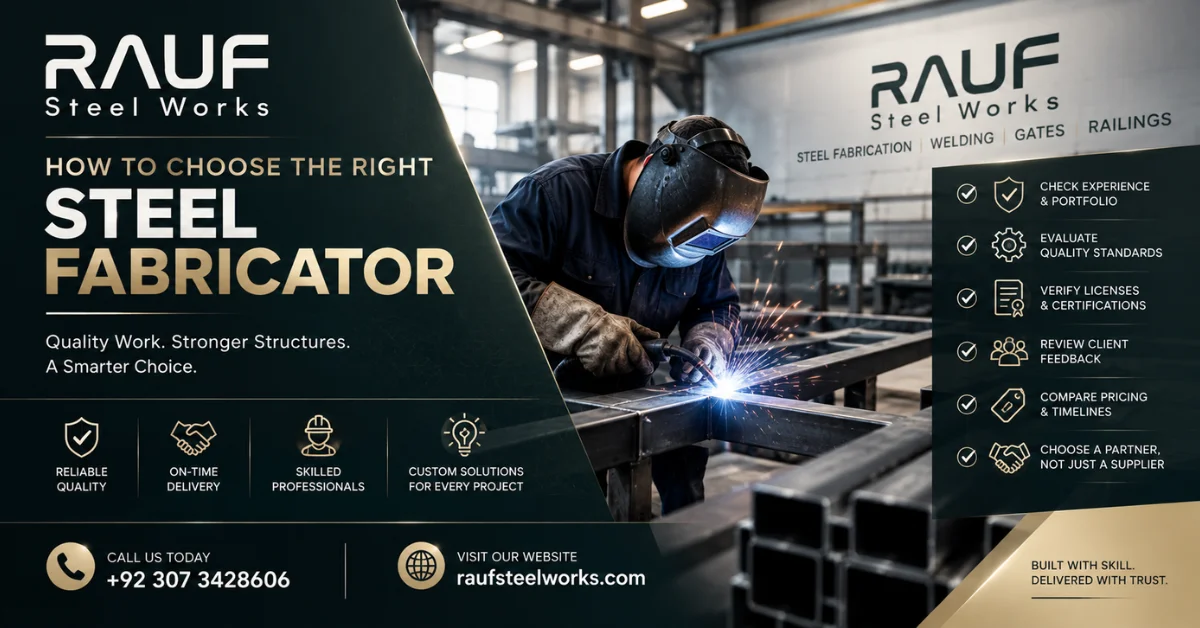
Picking a fabricator feels like it should be simple: get three quotes, take the middle one, hand over the job. In practice, that approach is exactly why so many homeowners and builders end up with sagging gates, rusting railings, and repair bills that arrive far sooner than expected. Knowing how to choose the right steel fabricator is less about finding the cheapest quote and more about identifying who actually has the process, the skill, and the accountability to deliver work that holds up.
The financial stakes here are larger than most people assume. According to research compiled by PlanRadar on construction rework costs, rework accounts for between 1% and 20% of total project cost, with most studies clustering in the 4–10% range — and poor workmanship is one of the main drivers. Choosing a fabricator on price alone is one of the fastest ways to land in that range, because the money saved on the quote gets spent twice over on corrections.
This guide walks through exactly what to evaluate — welding quality, materials, process, quote transparency, and the red flags that should end a conversation early — so you can vet any steel fabrication provider with confidence rather than guessing.
1. Start With Welding Quality, Not Price
Welding is the single most important variable in any fabrication job, because it’s where a structure either gains its strength or quietly loses it. The industry benchmark for this is the AWS D1.1 Structural Welding Code — Steel, published by the American Welding Society, which establishes requirements for welding structural steel including procedure qualification, welder qualification, fabrication, inspection, and acceptance criteria. You don’t need your local fabricator to be formally D1.1-certified for a home gate, but you do want evidence that they understand and apply the principles behind it.
What to actually look for when inspecting a fabricator’s past work:
- Consistent, uniform weld beads rather than lumpy, uneven joints
- Full penetration at joints, not surface tacking that looks fine until load is applied
- Clean finishing at weld points — ground smooth and properly coated, since unfinished weld areas are a common corrosion starting point
- No visible undercut or porosity along the weld line
If a fabricator can’t or won’t show you completed work up close, that’s information in itself.
2. Verify Material Grade — Don’t Assume It
“Steel is steel” is a costly assumption. The difference between properly specified material and whatever was cheapest that week shows up within the first monsoon season. Ask directly what grade is being used, and for stainless work, which grade specifically — as materials guidance from Trivantage on stainless grades explains, grades with higher chromium and nickel content support longer-lasting passive films, while lower-alloyed stainless steels are more vulnerable to corrosion, especially at welded areas.
For mild steel work, the equivalent question is about finishing: is the metal being primed with an anti-rust coating before painting, or just painted directly over bare steel? This single step is the difference between a gate that holds its finish for years and one that shows rust within months. The material choice between mild and stainless steel should be a conversation the fabricator initiates, not something you have to bring up yourself.
3. Check That They Follow an Actual Process
Good fabrication work isn’t improvised. Industry guidance on vetting fabrication partners emphasizes documented processes and quality control systems as what separates capable fabricators from those who overpromise — and while a residential gate doesn’t need an aerospace-grade QC manual, the underlying logic is identical at any scale.
A reliable fabricator should be able to describe, without hesitation:
- Consultation — site visit, accurate measurement, understanding what you actually need
- Planning — material specification, design confirmation, realistic timeline
- Execution — cutting, welding, and assembly with attention to load points
- Finishing — priming, painting, powder coating, or polishing as appropriate
- Delivery — final inspection and walkthrough before the job is considered done
A shop that jumps straight from “sure, we can do that” to cutting metal has skipped the two stages where most problems get prevented.
4. Demand an Itemized Quote
This is the single most practical filter available to you. A checklist from Victory Industrial Construction on choosing a fabrication partner specifically recommends requesting an itemized quote from each prospective fabricator rather than accepting a lump-sum figure — and the reasoning is straightforward: you cannot compare three quotes fairly if you don’t know what’s inside them.
Your quote should separate out:
- Material type, grade, and quantity
- Fabrication and labor cost
- Finishing process and materials (primer, paint type, powder coating)
- Hardware (hinges, locks, tracks, rollers)
- Installation
- Delivery timeline
A fabricator quoting a single number with no breakdown is either disorganized or leaving themselves room to substitute cheaper material later. Neither is what you want.
5. Look at Range of Capability
A shop that handles MS works, SS works, gates, railings, safety grills, fiberglass sheds, and solar panel frames under one roof generally reflects broader hands-on experience than one that only does a single category. It also solves a practical coordination problem: when a full property needs gates, boundary railings, staircase railings, and a rooftop shed, using one fabricator means everything is finished to match rather than looking assembled from four different vendors.
This is part of why property owners across Lahore increasingly look for a single fabrication partner rather than piecing work together — and it’s the model Rauf Steel Works operates on, handling the full scope from consultation through final delivery.
Comparison: Signs of a Reliable vs. Risky Fabricator
| Factor | Reliable Fabricator | Risky Fabricator |
| Quoting | Itemized breakdown of material, labor, finish | Single lump-sum number, “it depends” |
| Material | Names the grade, explains why it suits the job | Vague — “good quality steel” |
| Portfolio | Shows completed projects, happy to be inspected | Photos only, or none at all |
| Process | Describes consultation → delivery clearly | Starts cutting immediately |
| Finishing | Primes before painting as standard | Paints directly over bare steel |
| Timeline | Gives a specific date and commits to it | Open-ended, keeps shifting |
| After-sales | Offers adjustment/repair support | Unreachable once paid |
6. Ask These Questions Before You Commit
A short, direct conversation exposes more than any amount of online browsing:
- What grade of steel are you using, and why that grade for this job?
- Do you prime before painting, and what paint type do you use?
- Can I see a completed project similar to mine — in person if possible?
- Who does the actual welding, and how long have they been doing it?
- What’s your realistic timeline, and what happens if you’re delayed?
- Do you offer support if something needs adjustment after installation?
A fabricator who answers all six clearly and specifically is almost always the safer choice over one who deflects on even one or two.
Red Flags That Should End the Conversation
Guidance from Steel Creations Fabrication on fabrication shop red flags identifies vague or inconsistent pricing as a primary warning sign — a quote that shifts without explanation signals either disorganization or an intention to renegotiate mid-project. Alongside that, walk away when you encounter:
- Unwillingness to show any completed work
- A quote dramatically below every other bid you’ve received
- No written documentation of scope, material, or timeline
- Pressure to pay a large deposit before any scope is documented
- Evasiveness about who is actually performing the welding
- No contactable references from previous clients
7. Match the Fabricator to Your Project Type
Residential and commercial fabrication demand different strengths. A home gate or staircase railing prioritizes design quality, finishing, and safety tolerances — railings in particular are structural safety fixtures with code-driven height and spacing requirements, so a fabricator experienced specifically in load-bearing work matters more here than one who mainly does decorative pieces.
Commercial and industrial work shifts the priorities toward load capacity, batch consistency across multiple units, and schedule reliability, since fabrication delays can hold up an entire construction timeline. A fabricator experienced in both can scale either way; one who only does small decorative jobs will struggle with the second category.
Common Mistakes When Choosing a Fabricator
- Selecting purely on the lowest quote without knowing what material and finish it includes
- Accepting verbal agreements instead of a written, itemized scope
- Not inspecting any completed work in person before committing
- Assuming every fabricator handles structural work as competently as decorative work
- Skipping questions about finishing process, then being surprised by early rust
- Failing to confirm who is physically doing the welding versus who quoted the job
Final Thoughts
Learning how to choose the right steel fabricator comes down to a few disciplined habits: inspect real welds before you trust a claim, confirm material grade in writing, insist on an itemized quote, and treat evasiveness on any of these as a disqualifier rather than a quirk. The fabricator who answers these questions patiently and specifically is rarely the cheapest bid — but with industry research consistently putting rework at several percentage points of total project cost, the cheapest bid rarely stays cheapest for long.
Planning a gate, railing, shed, or custom fabrication project in Lahore and want a quote that spells out exactly what you’re paying for? Get in touch with Rauf Steel Works for a free consultation and itemized estimate.
📞 Call Us Today: 0307 3428606
FAQs
What is the most important factor when choosing a steel fabricator?
Welding quality, above everything else. A fabricator can use good material and still produce a weak structure if joints are surface-tacked rather than fully penetrated. Always inspect completed welds before committing.
Should I always choose the cheapest fabrication quote?
No. A quote significantly below every other bid usually means thinner material, skipped priming, or rushed welding — costs that resurface as repairs. Compare itemized quotes on what’s actually included rather than on the final number alone.
How can I tell if a fabricator uses good quality steel?
Ask them to name the specific grade and explain why it suits your project, then have it written into the quote. A fabricator who answers with “good quality steel” and nothing more isn’t giving you anything verifiable.
Does a steel fabricator need formal certification for residential work?
Formal certifications like AWS D1.1 are typically expected for structural and commercial projects rather than home gates or railings. For residential work, what matters more is demonstrated craftsmanship, a clear process, and inspectable completed projects.
How long should a fabrication project take?
Most residential gate or railing projects run about one to two weeks from design approval to installation. Larger commercial jobs take longer — the key is that the fabricator commits to a specific date rather than an open-ended estimate.