
A boundary wall or fence is usually the first thing a potential intruder evaluates before deciding whether a property is worth the risk. Most homeowners think of fencing purely in terms of privacy or property lines, but the material, height, and design of that fence directly influence whether it actually functions as a security barrier or just a visual one.
The research backs this up more concretely than most people expect. A study cited by Pittsburgh Fence Co on the psychology of security found that properties equipped with fences were 30% less likely to experience a burglary compared to those without one, with the National Crime Prevention Council identifying “opportunity reduction” as the most consistent predictor of crime deterrence — in other words, the harder it looks to get in, the less likely someone is to try.
Perhaps the most telling data point comes directly from offenders themselves. A widely cited study by researcher Joseph Kuhns at the University of North Carolina at Charlotte, interviewing 422 incarcerated burglars about how they chose their targets, found that tall fences with difficult-to-climb tops — iron or steel fencing with pointed or angled tips — ranked among the top deterrents they actively avoided. This guide walks through the steel fencing styles that create this effect, what actually makes a design hard to breach, and how to choose the right one for your property.
Why Steel Outperforms Other Fencing Materials for Security
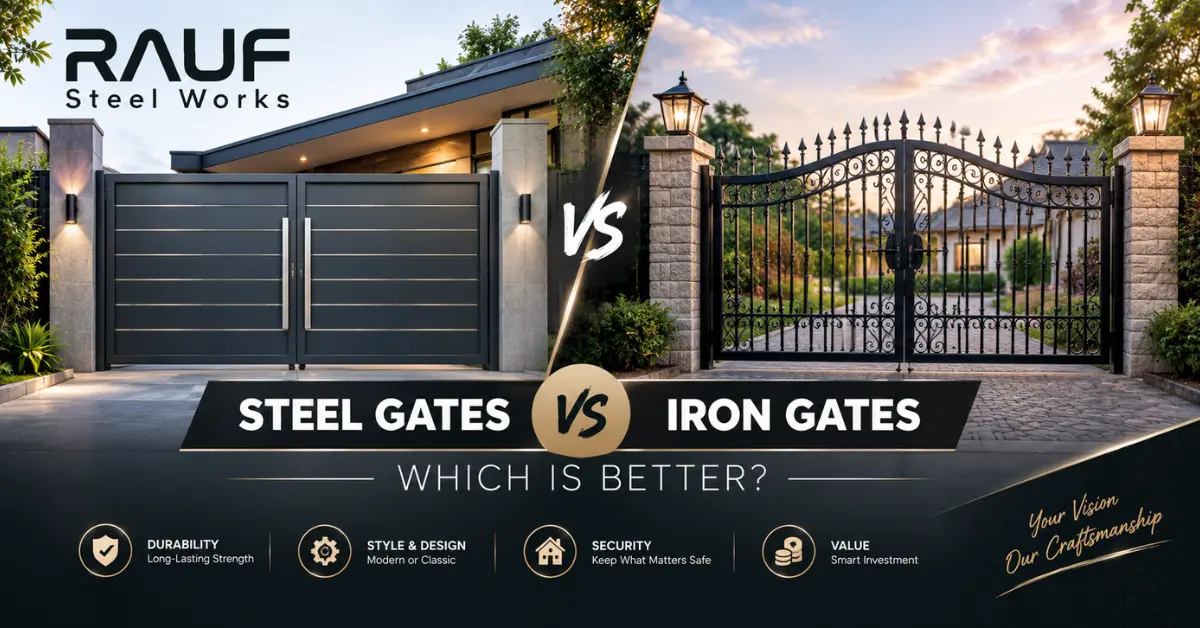
Material choice matters as much as design. According to a materials comparison from Freedom Fence on burglary-resistant fencing, steel panels are specifically named among the strongest options for preventing break-ins, cited for high durability and resistance to force — a category wood and vinyl fencing simply can’t match, since both can be kicked through, pried apart, or cut with basic hand tools. Steel’s combination of strength and workability is also why it’s the material most commonly used for gates and structural fabrication work across Lahore, since it holds a design’s exact dimensions and resists the kind of tampering that weaker materials can’t.
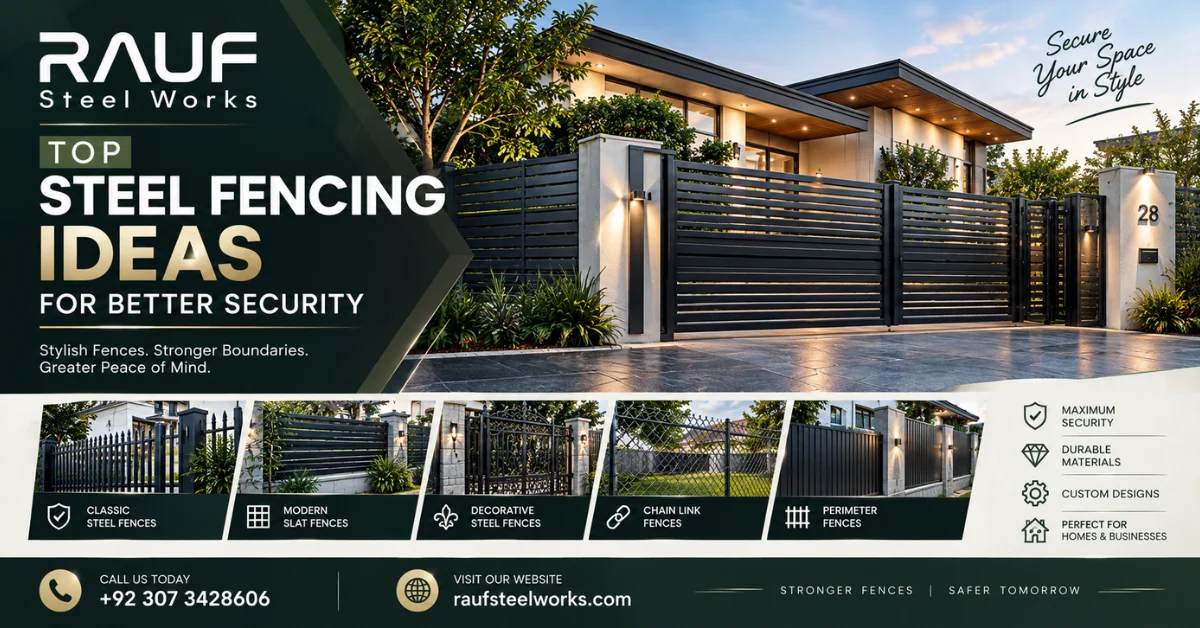
Top Steel Fencing Ideas for Better Security
1. Palisade Fencing
Palisade fencing uses vertical steel pales with pointed or D-shaped tops, spaced closely enough to prevent gaps a person could squeeze through. It’s one of the most widely used high-security fencing styles globally precisely because the pointed top creates a genuine physical deterrent to climbing, not just a visual one. It suits boundary walls, commercial perimeters, and larger residential plots where a strong security statement matters more than a softer aesthetic.
2. Vertical Bar (Picket) Fencing
A more refined take on the same principle — slim, evenly spaced vertical steel bars, often finished with a decorative but still difficult-to-grip top detail. It maintains visibility into and out of the property, which matters for a reason most homeowners don’t consider: unbroken sightlines let neighbors, passersby, and residents themselves notice anything unusual, which is its own layer of deterrence.
3. Anti-Climb Welded Mesh Fencing
Welded steel mesh panels, with openings small enough to prevent footholds, are increasingly used where a modern look is wanted alongside genuine security performance. Guidance from Campus Safety Magazine on anti-climb fence design notes that tightly spaced pickets or pales that curve outward at the top can delay or stop climbing attempts outright, and that ornamental steel with a powder-coated finish can communicate strength without looking institutional — a balance that works just as well for a home as it does for a commercial site.
4. Spear-Top Ornamental Fencing
This style combines classic wrought-iron-style aesthetics with a genuinely functional deterrent — the spear-shaped finials at the top of each bar are difficult to grip and uncomfortable to climb over. It’s a popular choice for homes that want a fence to look established and high-end rather than purely utilitarian, without sacrificing the anti-climb function.
5. Slatted Privacy Fencing with Steel Framing
For property owners who want privacy alongside security, a steel-framed fence with closely spaced horizontal or vertical slats blocks visibility while keeping the structural strength of steel. The trade-off, discussed further below, is that full privacy fencing removes the natural-surveillance benefit that open designs provide — worth weighing based on your specific property and street.
6. Reinforced Boundary Wall Toppers
For properties that already have a masonry boundary wall, adding a steel picket or spike topper significantly increases the height and difficulty of scaling it without a full fence rebuild. This is one of the most cost-effective upgrades available, since it uses the existing wall as its base.
How Height Actually Affects Security
Height isn’t a minor design detail — it’s one of the most studied variables in fence security. A security fencing guide published by the RCMP states plainly that fences of 2 meters or less shouldn’t really be called security fencing, since most adults can reach and clear that height quickly — even with a hostile topper added. The guide recommends a minimum of 2.4 meters for a fence to function as a genuine security barrier, with increasing height directly increasing both the physical and psychological delay it creates for an intruder.
For most residential properties in Lahore, matching this exactly isn’t always practical or in keeping with local streetscapes, but the underlying principle still applies: a taller fence with a hostile top detail delays and discourages far more effectively than a low decorative one, and every extra half-foot of height meaningfully raises the effort required to get over it.
Comparing Steel Fencing Styles for Security
| Style | Security Level | Privacy | Visibility/Sightlines | Best For |
| Palisade | Very high | Low | Good | Boundary walls, commercial perimeters |
| Vertical bar/picket | High | Low | Excellent | Homes wanting visibility + deterrence |
| Anti-climb welded mesh | High | Low–moderate | Good | Modern homes, commercial sites |
| Spear-top ornamental | High | Low | Good | Premium residential frontage |
| Slatted privacy (steel-framed) | Moderate–high | High | Poor | Homes prioritizing privacy over sightlines |
| Wall topper (spikes/pickets) | Moderate–high | N/A | N/A | Existing boundary walls needing an upgrade |
Design Details That Make a Real Difference
- Picket spacing — gaps wide enough to fit a hand or foot through defeat the purpose of an otherwise strong design.
- Hostile top details — spear tips, D-tops, or outward-curved pales all add genuine climbing resistance beyond height alone.
- Weld quality at joints — a fence is only as strong as its weakest weld; a panel that can be pried apart at a joint isn’t offering real resistance.
- Gate integration — a strong fence paired with a weak gate is a wasted investment, since intruders will always test the weakest point first.
- Finish and corrosion resistance — a rusted, weakened fence loses structural integrity over time; proper priming and painting (or stainless steel for high-exposure areas) keeps the barrier at full strength for years.
Security vs. Aesthetics: Finding the Balance
There’s a real tension between maximum security and a welcoming property appearance, and most homeowners land somewhere in the middle rather than at either extreme. The Campus Safety Magazine guidance referenced earlier makes a useful point here — ornamental steel pickets and black powder-coated finishes can communicate strength without appearing oppressive, which is exactly the balance most residential clients are actually looking for: a fence that looks intentional and well-designed, not like a prison perimeter, while still doing its job.
Common Mistakes When Choosing Security Fencing
- Choosing a decorative style purely for looks without checking picket spacing or top-detail security value.
- Installing a strong fence but leaving an old, weak gate as the main entry point.
- Going too low on height to save cost, undermining the entire investment.
- Skipping anti-rust priming, which shortens the fence’s structural life well before it should need replacing.
- Choosing full-privacy paneling without considering the loss of natural surveillance it creates.
- Assuming any welded steel automatically means strong joints — weld quality varies significantly between fabricators.
Final Thoughts
Steel fencing genuinely earns its reputation as one of the strongest available security upgrades — but only when the style, height, picket spacing, and weld quality are all specified correctly. A palisade or spear-top design with proper height and tight spacing does real, measurable work in deterring intruders, backed by both offender interviews and physical security research, not just marketing claims.
If you’re planning a boundary fence, wall topper, or full perimeter upgrade, get in touch with Rauf Steel Works for a free consultation on the right steel fencing design for your property’s security and budget.
📞 Call Us Today: 0307 3428606
FAQs
Which type of steel fencing offers the best security?
Palisade and spear-top designs generally offer the strongest deterrent, since their pointed or hostile top details make climbing genuinely difficult, not just visually imposing. Anti-climb welded mesh is a strong modern alternative with similar performance.
Does fence height really matter for security?
Yes, significantly. Security research indicates fences under roughly 2 meters function as little more than a passive deterrent, while height above that threshold substantially increases the time and difficulty required to climb over.
Is steel fencing better than a boundary wall alone?
A steel topper added to an existing boundary wall is one of the most cost-effective security upgrades available, since it raises the effective height and difficulty of scaling the wall without a full rebuild.
Do privacy fences reduce security?
Full-privacy paneling blocks visibility both ways, which removes the natural-surveillance benefit that open picket or palisade designs offer. It’s not inherently less secure, but it does trade one form of deterrence for another, and the choice should match the specific property.
How much does steel security fencing cost compared to other materials?
Steel typically costs more upfront than wood but outlasts it significantly with proper finishing, avoiding the repeated repair and replacement costs wood or lower-grade materials require after a few years of exposure.