
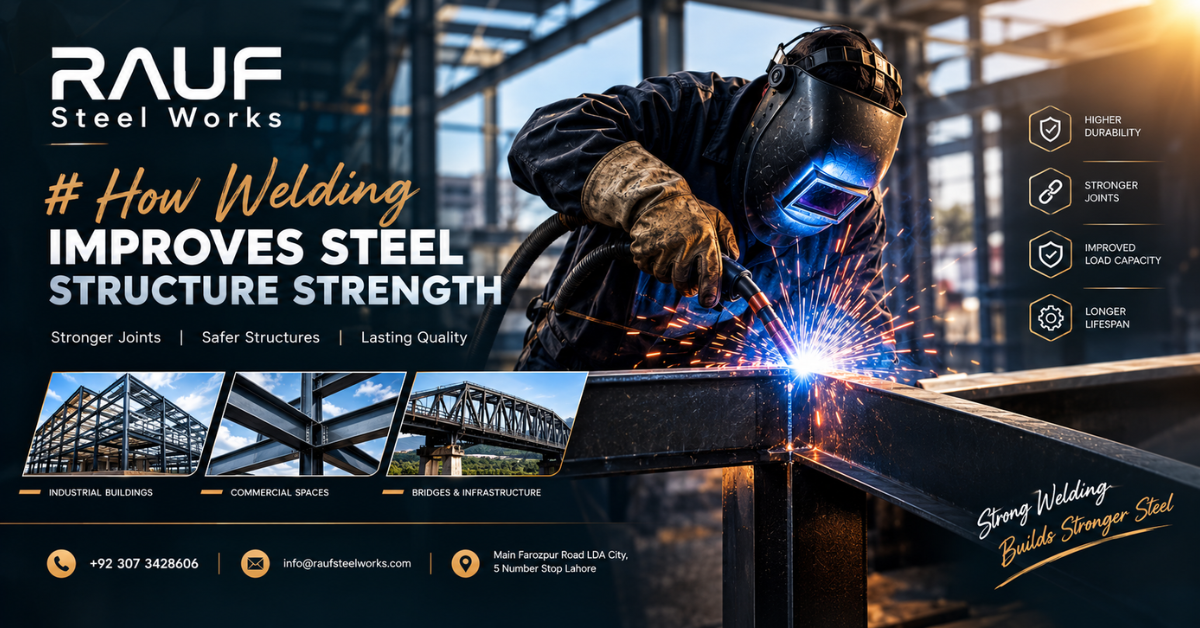
Welding does not make steel itself stronger. It does something just as important: it joins separate pieces into one continuous structure. A frame, gate, or staircase carries load through its joints. If the joints fail, the steel between them does not matter.
At Rauf Steel Works in Lahore, welding sits at the centre of most jobs. That includes gates, railings, solar panel frames, and repairs. This guide explains how good welding builds steel structure strength. It also covers the defects that weaken it and what to ask your fabricator. If you want to see the full range of work first, the services page lists it.
Why Joints Decide Steel Structure Strength
A steel beam can be very strong on its own. Steel structure strength, however, depends on the weakest connection. Every load travels from one member to the next through a joint. A weak joint breaks that chain.
Welding fuses the pieces together with molten filler metal. When the weld is sound, the joint carries load much like the steel around it. That is why welding is the standard way to build custom frames, stairs, and fences.
How Welding Builds Steel Structure Strength
Welding improves steel structure strength in three practical ways.
It Creates a Continuous Load Path
The Steel Construction Institute’s guidance on moment resisting connections states that welded connections can provide full moment continuity. In plain terms, the beam and column act as one rigid unit. They resist bending together instead of rotating at the joint.
The same guidance adds that statically indeterminate frames need full strength welds on the flanges and the web. Designers do not leave this to chance.
It Removes Extra Parts
A welded joint needs no extra plates, bolts, or overlaps in many cases. Fewer parts mean fewer places to loosen, rattle, or rust. This also helps appearance. A welded railing or gate frame looks clean because the joints disappear into the steel.
It Can Be Controlled in the Workshop
The same Steel Construction Institute page favours shop welding, because the welder works under controlled conditions. A workshop lets the fabricator clean the joint, position the piece, and inspect the weld. Site welding is harder to control, and the guidance describes it as expensive.
Welded vs Bolted Joints
Welding is not always the right answer. Bolting has its place. This comparison draws on the Steel Construction Institute guidance above and on common workshop practice.
| Factor | Welded joint | Bolted joint |
| Load path | Can give full moment continuity | Common for moment connections through bolted end plates |
| Cost on site | Higher, especially for site welding | Generally lower for site assembly |
| Quality control | Best in a controlled workshop | Depends on correct bolt tightening |
| Inspection | Needs weld inspection | Needs bolt checks |
| Best for | Custom frames, gates, stairs, railings | Large structures assembled on site |
Many projects use both. A fabricator may weld sections in the workshop and bolt them together at the property. Ask which method suits your job and why.
What a Strong Weld Requires
Steel structure strength is only as good as the work behind each weld. The American Welding Society’s D1.1 Structural Welding Code for Steel shows how much goes into it. The code covers welding procedure qualification, welder qualification, fabrication and workmanship, inspection methods, and weld acceptance criteria.
You do not need a formal code for a garden gate. The same ideas still apply at every scale:
- A qualified welder who has proven the skill.
- A defined procedure that fits the steel and the joint.
- A clean joint with no paint, grease, or rust.
- inspection before you accept the work.
Weld Defects That Reduce Steel Structure Strength
Poor welding can undo the steel structure strength a good design promises. ESAB’s guide to weld defects and remedies lists the main problems and how they affect strength.
| Defect | What happens | Effect on strength (per ESAB) |
| Porosity | Gas pockets trap inside the weld | Can seriously weaken the weld |
| Slag inclusions | Non-metal particles stay in the weld | Create weak spots |
| Undercut | A groove forms along the edge of the weld | Can reduce structural integrity |
| Lack of fusion | The weld fails to bond with the steel | Strength and integrity drop significantly |
| Lack of penetration | The weld does not reach through the joint | Reduces load-bearing capacity |
| Cracks | Fractures form in the weld or nearby steel | Can spread under load |
Most of these defects have simple causes. Dirty metal, damp electrodes, wrong current, and rushed travel speed top the list. A careful welder avoids them by cleaning the joint and controlling the process.
Heat and Cracking: A Hidden Strength Risk
Welding adds intense heat to the steel structure, and the steel then cools quickly. This can cause cracks in the weld or the steel next to it. TWI, a leading welding research body, explains hydrogen cracking. It needs three things together. These are hydrogen from the welding process, a hard and brittle structure, and tensile stress on the joint.
Welders break that combination in several ways:
- Preheating the steel to slow cooling and let hydrogen escape.
- Using low hydrogen electrodes and drying them as the maker instructs.
- Removing paint, oil, and grease from the joint faces.
- Avoiding large gaps and high restraint in the joint.
TWI calls reducing hydrogen in the weld metal the most effective means of preventing these cracks. The takeaway for buyers is simple. Good welding is a process, not just a skill with a torch.
Welding for Homes and Businesses in Lahore
Most property owners in Lahore never think about weld theory. They think about a gate that sags, a railing that wobbles, or a shed frame that rusts at the joints. Those problems usually trace back to weak welds or missing finish.
Good welding raises steel structure strength where you notice it daily:
- Gates keep their alignment because the frame stays rigid.
- Stairs and railings hold up under constant gripping and leaning.
- Solar panel frames stay put through wind and monsoon rain.
- Repairs restore strength to damaged frames without full replacement.
Material still matters. Welded mild steel needs a proper coating at the joints, while stainless steel handles weather better. Our comparison of mild steel vs stainless steel explains the trade-offs.
How to Check Steel Structure Strength Before You Pay
You can judge a lot about steel structure strength without special tools. Look at the finished weld and ask questions.
- Look for smooth, even beads with no holes or gaps.
- Check that the weld runs the full length of each joint.
- Watch for cracks, sharp notches, or sticky spatter around the joint.
- Ask who did the welding and how the team checks the work.
- Ask what coating protects the welded areas.
Rauf Steel Works describes a four-step process on its services page: consultation, planning, execution, and delivery. The delivery step includes a final inspection before handover. You can book a consultation to discuss your own project.
Common Mistakes to Avoid
- Choosing on price alone. A very low quote often hides rushed or unqualified welding.
- Ignoring joint preparation. Rust, paint, and grease cause defects.
- Skipping inspection. Always look at the work before the final payment.
- Overlooking coating. Welded joints need paint or another finish to resist rust.
- Using welding where bolting suits better. Match the method to the job.
- Welding over a damaged structure. Fix the cause of the damage first.
Final Thoughts
Welding improves steel structure strength by turning separate pieces into one continuous, load-carrying whole. The benefit depends entirely on quality. Clean joints, a qualified welder, a sound procedure, and a proper inspection decide the outcome. They separate a structure that lasts from one that fails early.
Planning a project in Lahore where steel structure strength matters? Contact Rauf Steel Works to talk through your project.
📞 Call Us Today: 0307 3428606
FAQs
Does welding make a steel structure stronger?
Not the steel itself. It improves the structure. Welding joins pieces into one continuous frame, and a sound weld lets the joint carry load like the surrounding steel.
Is welding stronger than bolting?
It depends on the job. Welded joints can give full moment continuity, while bolted joints often suit assembly on site. Many projects use both.
What lowers steel structure strength in a weld?
Defects such as porosity, slag inclusions, undercut, lack of fusion, and cracks. Dirty metal, wet electrodes, and wrong settings usually cause them.
Why do some welds crack after cooling?
Hydrogen cracking can occur when hydrogen, hard brittle steel, and tensile stress combine. Preheating and low hydrogen electrodes reduce the risk.
Do small projects like gates need the same standards?
A garden gate does not need a formal code. It still needs a clean joint, a skilled welder, and an inspection before you accept it.